
 EN
EN Türkçe




Why a backgammon board is a calendar
Thirty checkers, two dice, one board. Fifteen hundred years ago, someone in Persia sat down and wrote out what all of it meant — and that text still survives.
In the coffee house, at home, on the road. Backgammon is one of the most played games in Turkey and across the Middle East. But very few people know that the numbers on the board were not chosen at random.
Three things in this piece: what the board stands for, what the six faces of the dice mean, and the question a viewer asked under our video — what about the months with thirty-one days?
Where the text comes from
The source is a Middle Persian (Pahlavi) text from the Sasanian period:
Wizārišn ī Čatrang ud Nihišn ī Nēw-Ardaxšīr The Explanation of Chess and the Invention of Backgammon
In the story, an embassy arrives at the Sasanian court from India bearing a gift: chess. With it comes a challenge — work out the rules. Bozorgmehr, vizier to Khosrow I Anushirvan, solves it, then sends back a game of his own: nard. What we now call backgammon.
The Indian envoys cannot solve it. The king asks: so what does this game mean? Bozorgmehr's answer turns the board into a model of the world.
Whether Bozorgmehr existed is disputed. No vizier of that name is clearly attested in Sasanian records; he is most likely a literary figure. The text itself is real, though, and it reflects how the period thought.
What the board stands for
- The board
- The earth
- 30 checkers
- The thirty days of the month
- 15 white
- Day
- 15 black
- Night
- Their movement
- The turning of the sky and the stars
- The dice
- What a person cannot choose — fate
Setting the checkers on the board stands for birth; lifting them off stands for departure. One game, from beginning to end, is one life. The text also brings in the seven planets and the twelve signs of the zodiac, and ties the movement of the pieces to that order.
A common error: you will often read that the twenty-four points stand for the twenty-four hours of the day. That reading does not appear in the text; it is a later popular gloss. What the text actually says is that the thirty checkers are the days of the month, and the white and black are day and night.
The six faces of the dice
The text gives each number its own meaning.
- One — Ohrmazd The one who is single. The source of all good.
- Two — The two worlds Seen and unseen; matter and spirit. Mēnōg and gētīg.
- Three — The three principles Good thoughts, good words, good deeds.
- Four — Four elements, four directions Fire, air, water, earth.
- Five — The five lights Sun, moon, stars, fire, and the light that comes down from the sky.
- Six — The six Gahanbars The six seasonal feasts of creation.
So the dice never stood for luck. They stand for the part a person does not get to choose. Chess is played entirely by reason; there is no chance in it. Nard deliberately took chance and built it into the game.
You choose the move. You do not choose the roll.
So what about the thirty-one day months?
That was the best question we got. The answer is in the old Persian calendar.
It had no months of thirty-one days. Every month was exactly thirty.
12 months × 30 days = 360 days
The remaining five days of the solar year belonged to no month at all.
Those five days were not distributed among the months. They were placed at the end of the year and kept apart — days belonging to no month. In the Zoroastrian tradition they are the Gatha days, each dedicated to one of the hymns of Zarathustra. Nowruz follows immediately, and the year begins again.
The calendar was never broken. The remainder was simply kept outside it.
Which is why the thirty checkers on the board mapped exactly onto one month. Months of thirty-one days came much later, from the Roman calendar.
And the quarter day?
The solar year is not exactly 365 days but roughly 365.25. Add 360 and 5 and a quarter day is still left over, so the calendar drifts by a day every four years.
The old calendar had no regular fix for this. Sources mention attempts to intercalate an extra month roughly every 120 years, but whether that was ever carried out systematically is disputed.
The problem was solved much later. In 1079, under Malik Shah, a team of astronomers that included Omar Khayyam produced the Jalali calendar. It ties the start of the year to the observed spring equinox, which makes it more accurate than the Gregorian calendar. It is the basis of the Iranian calendar still in use today.
Yes, the same Omar Khayyam. The poet of the Rubaiyat.
How old is the game itself?
The text is fifteen hundred years old. The game is far older.
The oldest complete board game set ever found came out of grave 731 at Shahr-e Sukhteh — the Burnt City — in Sistan, south-eastern Iran. Roughly 2600–2400 BCE.
The set held a board carved with a serpent coiling twenty times around itself, sixty pieces of turquoise and agate, and two dice.
Is it the ancestor of backgammon? That is hard to claim directly. Senet in Egypt is older, though no complete set survives; the Royal Game of Ur in Mesopotamia is roughly the same age. What makes the Shahr-e Sukhteh find remarkable is not that it is the oldest — it is that it is the oldest complete set ever recovered.
In short
- The board was designed as a model of the world: the board is the earth, the checkers are people, the dice are fate.
- Thirty checkers for thirty days; fifteen white for day, fifteen black for night.
- Each of the six faces of the dice carries its own meaning.
- In the old Persian calendar every month was thirty days, with five days kept apart at the end of the year.
- The leftover quarter day was resolved in 1079 by Omar Khayyam and his colleagues.
Next time you sit down at the board, look at the pieces. You are holding a fifteen-hundred-year-old answer.
Sources
- Wizārišn ī Čatrang ud Nihišn ī Nēw-Ardaxšīr — Middle Persian text. Its oldest surviving copy is the MK codex, transcribed in 1322 by Mihrābān Kayhusraw.
- Jamasp-Asana, Pahlavi Texts, Bombay, 1897–1913 — the first printed edition.
- Touraj Daryaee, On the Explanation of Chess and Backgammon, 2016 — transcription and translation.
- Touraj Daryaee, "Mind, Body, and the Cosmos: Chess and Backgammon in Ancient Persia", Iranian Studies 35, 2002.
- Ferdowsi, Shahnameh — the literary telling of the chess and nard story.
- Excavation reports from Shahr-e Sukhteh, Sistan and Baluchestan, Iran.
Ebrisem Gallery Panora AVM, Oran Mah. Turan Güneş Bulvarı No: 31/169, Çankaya, Ankara
Open daily, 10:00–22:00
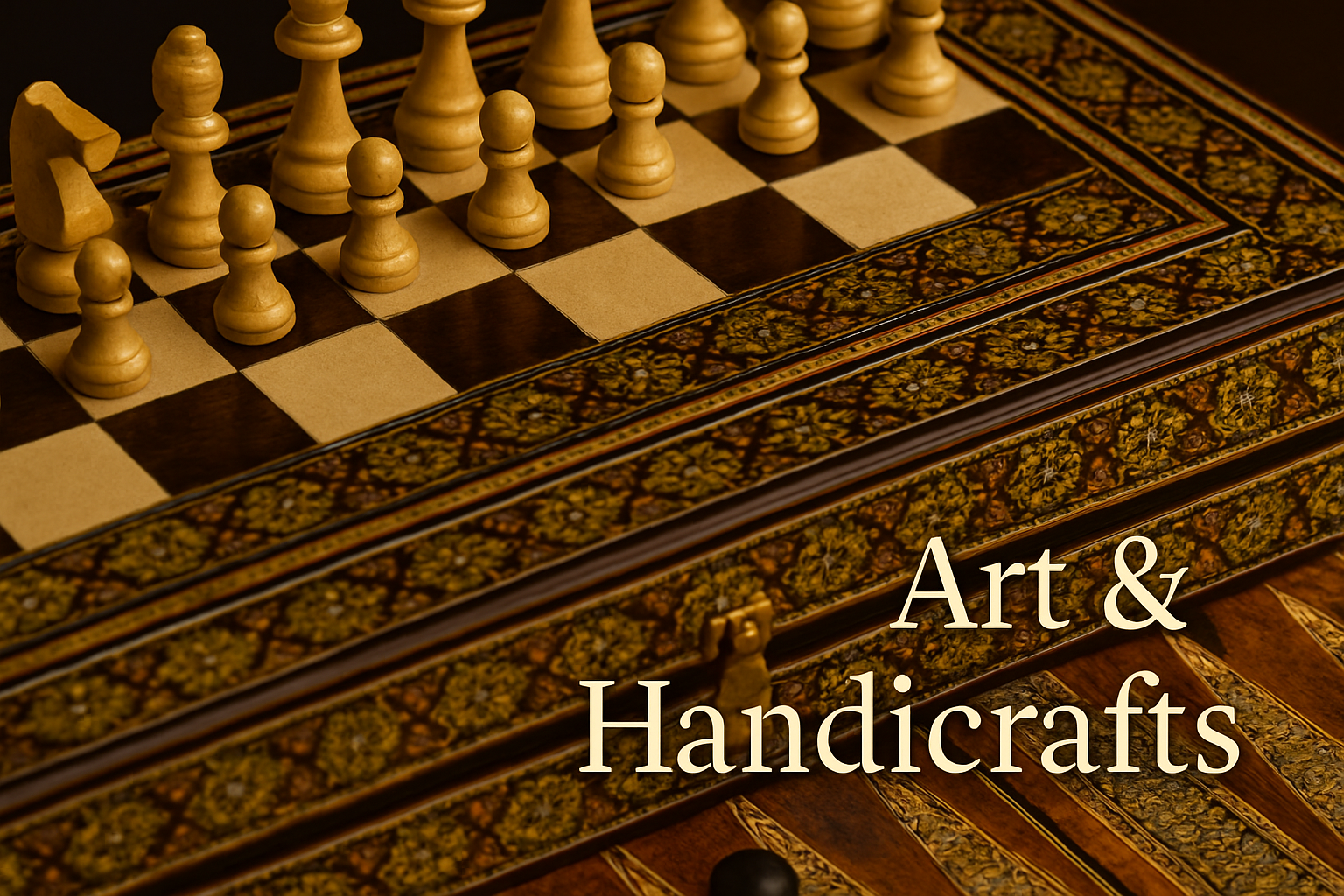
See our hand-inlaid Isfahan khatam backgammon sets in the collection.